Troubleshooting your Yale Smart Video Doorbell
Here you can find the answers about Troubleshooting your Yale Smart Video Doorbell
FAQ
1. Check Wi-Fi Compatibility and Signal Strength
Important: Yale Smart Video Doorbells only support 2.4 GHz Wi-Fi networks. They are not compatible with 5 GHz networks.
Steps to Troubleshoot:
- Verify your router’s frequency:
Ensure your router is broadcasting a 2.4 GHz signal. If you're using a dual-band router (2.4 GHz + 5 GHz), setup issues may occur if both bands share the same network name (SSID). - Split your Wi-Fi bands:
Rename the 2.4 GHz and 5 GHz networks with unique SSIDs (e.g., Home_2.4 and Home_5). Then, connect your phone to the 2.4 GHz network and retry the Doorbell setup. - Confirm your internet connection is active:
A router may still broadcast a network even if the internet is down. Test by opening a website in your browser. - Check signal strength at the device location:
Use a free speed test app to measure Wi-Fi quality where the Doorbell is installed. If the signal is weak, try moving the Doorbell closer to the router during setup.
2. Grant App Permissions
Connection issues may occur if the Yale Home app does not have the necessary permissions.
To ensure successful set up:
- Accept all permission prompts during app installation and device setup.
- Required permissions typically include:
- Bluetooth – for device discovery
- Location access – for Wi-Fi setup and connectivity
If these permissions are denied, the app may not be able to detect or connect to your Doorbell.
3. Ensure the Doorbell is Connected to Mains Power
If the Doorbell battery level is below 20% then you may not be able to set it up. For this reason, we always recommend having the Doorbell connected to mains power during set up.
4. Special Characters in Wi-Fi Network Name (SSID)
Yale Smart Video Doorbells running earlier firmware versions may fail to connect during setup if your Wi-Fi SSID (network name) or password contains special characters (e.g., commas, exclamation marks, symbols).
To successfully set up your Doorbell and update its firmware, follow these steps:
Option 1: Temporarily Change Your Router’s SSID
- Log in to your router settings and change the SSID (network name) to something simple—avoid special characters.
- Connect and setup the Doorbell to this simplified network.
- Allow the Doorbell to complete its firmware update.
- Factory reset the Doorbell.
- Revert your router’s SSID back to the original name (with special characters, if desired).
- Setup the Doorbell again, this time to your original network.
Option 2: Use an Alternative Network (e.g., Mobile Hotspot)
- Create a mobile hotspot on your phone with a simple SSID (no special characters).
- Setup the Doorbell to this hotspot.
- Wait for the firmware update to complete.
- Factory reset the Doorbell.
- Setup the Doorbell again, this time to your original network.
5. Doorbell Not Broadcasting Its SSID
When setting up your Doorbell, make sure it is in setup mode—this is indicated by a flashing green light.
In this mode, the Doorbell should broadcast its SSID. You can check this by opening your phone’s Wi-Fi settings and looking for the Doorbell in the list of available networks.
Once you find the Doorbells SSID, confirm that the serial number in the SSID matches the one printed on the product label.
If the serial numbers do not match, or you are unable to see the Doorbells SSID in the available network list, please contact Yale Customer Support for assistance.
6. Hardware Failure
If you've followed all the previous steps and still can't set up your Doorbell, we recommend performing a hardware reset.
You can find step-by-step reset instructions in the Support Centre within your Yale Home app.
If set up still fails after a successful reset, please reach out to Yale Customer Support for further assistance.
1. Move the Doorbell Closer to the Router or Access Point
To ensure a strong and stable Wi-Fi connection, position your device as close as possible to your router or the nearest mesh node.
Reconnecting to the Optimal Access Point After Mounting
If you set up your device near one Access Point (AP) but later mount it in a different location with a closer AP, the device may still connect to the original AP. This can affect performance unless the device is rebooted.
To ensure your device connects to the strongest available Wi-Fi signal:
- Locate the reboot button on the device.
- Press and hold the reboot button for a second.
- The Doorbell and its Wi-Fi module will restart.
- During the reboot, the device will scan for available Access Points and automatically connect to the one with the strongest signal (RSSI).
Note: If your Doorbell is running firmware version v1.5.23 or later, you can reboot it remotely from the devices settings, using the Yale Home app (if the Doorbell is online). This also triggers a re-scan for the strongest available Access Point.
This step is especially important in mesh or multi-AP environments to ensure optimal performance.
2. Check Your Yale Smart Video Doorbells Current Wi-Fi Signal Strength
To check your Doorbells current Wi-Fi signal strength, follow these steps in the Yale Home App:
- Open the Yale Home App.
- From the dashboard, tap on the Doorbell.
- Select the top right Settings option.
- Scroll to Utilities and select Wi-Fi Connection.
Once you're there, look for the RSSI (Received Signal Strength Indicator) value. Here's how to interpret it:
- Good Signal: ~ -40 to -55 dBm
- Poor Signal: ~ -65 dBm or lower
If your signal is poor, you might consider:
- Moving your router closer to the Doorbell.
- Reducing physical obstructions (like walls or metal objects).
- Using a Wi-Fi extender or mesh system.
3. Reconnect Your Doorbell to a Closer Wi-Fi Access Point
If you've moved your Doorbell after the initial setup, follow these steps to reconnect it to the strongest available Wi-Fi signal:
- Reboot the Doorbell
Press and hold the reboot button for a second. - Wait for Reboot
The Doorbell will automatically restart and connect to the strongest available Wi-Fi network. - Check Signal Strength
Once the Doorbell has rebooted, open the Yale Home app and check the Doorbells signal strength again, as per the steps in section 2.
4. Try Fully Reinstalling the Doorbell
To reset your Doorbell, please follow the process below.
- Open the Yale Home app.
- Select your Doorbell and then the top right Settings icon.
- Scroll down to Utilities and select Remove Device.
Once the Doorbell is removed, you will also need to manually reset the device.
- Use the provided pin tool to remove the Doorbell from the backplate and locate the On/Off button pictured below-
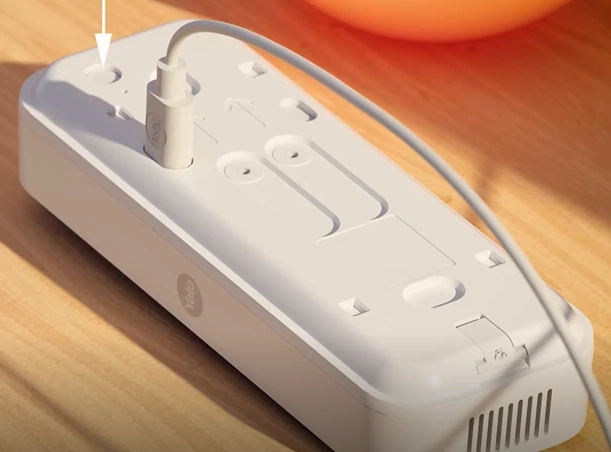
- Press and hold this button until you hear a beep (at least 12 seconds).
- Release the button, you will see a sequence of green and red LED flashes around the Doorbell push button.
- Wait 60 seconds for the Doorbell to fully reboot. The device is now removed from your app and reset.
Once this has been completed, please select the top right "+" option from your Yale Home app dashboard, to setup the Doorbell again.
You can reset your password in the app by choosing Forgot Password from the login screen, or alternatively- via the online account management portal.
Key Cause: High motion sensitivity in busy areas is the most common reason for rapid battery drain. Each motion event wakes the device from sleep mode to record, consuming battery.
Battery-Saving Tips: Adjusting the following device settings to match the installation environment can significantly extend battery life. You’ll find these options in the device settings within the Yale Home app.
-
Motion Detection Settings
- Avoid enabling “All Other Motion Detection” in high-traffic areas.
- Use “Human Detection” to reduce unnecessary triggers.
- Optional filters (with subscription): Pet, Package, and Vehicle Detection.
-
Motion Sensitivity
- Lower sensitivity to reduce detection range and limit frequent activations.
-
Detection Zone
- Exclude busy areas (e.g., roads, footpaths) using the zone editor to prevent unwanted triggers.
-
Clip Length
- Set shorter recording durations (10–60 seconds).
- Enable “End Recording When Motion Stops” to avoid extended recordings.
-
Motion Re-Trigger Time
- Add a delay (10–60 seconds) between recordings to reduce battery use during continuous motion.
Still Experiencing Issues? Consider continuous power options:
Video Doorbell power options:
- Existing Wiring: Use an 8–24VAC bell transformer.
- Yale AC Power Adapter: Plugs into a mains socket with 8m cable.
If your old mechanical chime is making a buzzing noise after installing your Yale Smart Video Doorbell, it likely means the chime is still connected to the power supply. As a result, it may vibrate or buzz due to electrical current passing through it.
To resolve this issue, please disconnect the mechanical chime and bypass the power using the provided fuse.
You can view the physical installation instructions in the device settings:
- Open the Yale Home app.
- From the dashboard, tap on your Doorbell.
- Tap the Settings icon in the top right corner.
- Scroll down and select Installation Guide.
Alternatively, you can Click here to watch our setup video for step-by-step instructions on installing your Yale Smart Video Doorbell.
Rebooting your Yale Smart Video Doorbell temporarily disconnects the internal battery, allowing the system to refresh and resolve minor issues.
You can reboot the device in two ways:
- Via the Yale Home App
- Directly on the Doorbell Unit
1: Reboot via the Yale Home App
- Open the Yale Home app.
- From the dashboard, tap on your Doorbell.
- Tap the Settings icon in the top right corner.
- Scroll down to Utilities and select Restart Device.
Once restarted, the outer ring of the Doorbell will blink green, indicating a successful reboot.
2: Reboot via the Doorbell Unit
- Use the security pin tool included in the box to remove the Doorbell from its backplate.
- Locate the small button next to the power button on the rear of the unit.
- Press this button for 1 second.
The device will then reboot automatically.
A hardware reset restores your Yale Smart Video Doorbell to factory settings. This process:
- Removes: Wi-Fi network settings and internally stored video clips.
- Retains: Registration to the current user’s Yale Home account and cloud-stored data.
Important: A hardware reset does not remove the device from your Yale Home account. Video clips stored in the cloud and the device’s registration remain intact. Removal from a Yale Home account is covered in Step 2.
Step 1: To Perform a Hardware Reset:
- Locate the on/off button on the back of the doorbell.
- Press and hold the button for approximately 10 seconds.
- You’ll hear a beep — release the button.
- The LED ring will:
- Flash red/green
- Turn off briefly
- Then flash green steadily
This indicates the reset was successful and the device is rebooting.
Important: After a reset, the doorbell can only be set up again if it’s removed from the original owner’s account - as per the next steps below. This prevents stolen devices from being re-registered.
Step 2: To Remove the Doorbell from Your Yale Home Account:
- Open the Yale Home app.
- From the dashboard, tap on your Doorbell.
- Tap the Settings icon (top right corner).
- Scroll down to Utilities and select Remove Device.
- Follow the on-screen prompts.
Final Notes:
- Resetting is useful when changing Wi-Fi networks or preparing the device for a new location.
- Always ensure the device is removed from your account before transferring ownership.
If you've recharged the battery in your Yale Smart Video Doorbell and the device still doesn't power on, a reboot may be required. Normally, the doorbell powers on automatically once the battery is charged. However, in some cases, a manual reboot is necessary.
To reboot your doorbell:
- Use the security pin tool (included in the box) to remove the doorbell from its backplate, if it's not already detached.
- Locate the small reset button next to the power button on the rear of the unit.
- Using the pin tool, press and hold the reset button for 1 second.
- The device will reboot automatically.
After rebooting, your doorbell should power on as expected.
A tamper alert appears when the doorbell isn’t fully pressed against its mounting plate. The device contains a small tamper switch on the back that must be fully compressed when installed. If it isn’t, the Yale Home app will show a tamper warning.
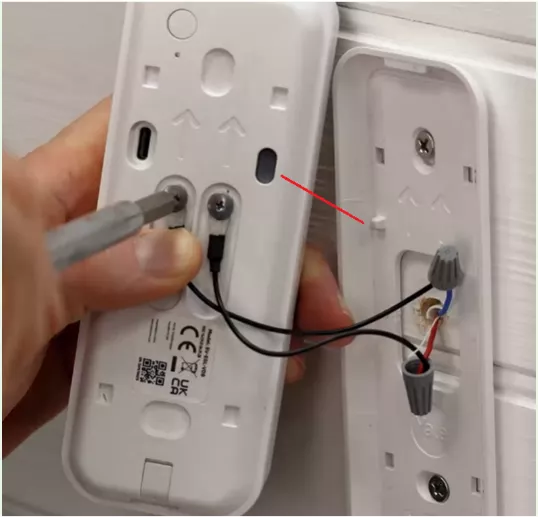
Common causes include:
- The doorbell being removed from the backplate (e.g., for charging)
- The backplate not seated correctly or mounted on an uneven surface
- A warped or damaged backplate
- Damage to the doorbell casing or tamper switch
How to clear the tamper alert:
- Remove the doorbell from the backplate.
- Check the tamper switch for visible damage.
- Inspect the mounting plate for warping or cracks.
- Make sure the spring‑loaded bottom clip moves freely.
- Reattach the doorbell firmly onto the backplate.
- Press it securely into place.
- Open the Yale Home app to confirm the tamper alert has cleared.
This is expected behaviour and is part of the doorbell’s design. The PIR sensor always remains active for basic wake‑up functions, and when it detects nearby movement it briefly wakes the device to illuminate the green doorbell button LED. This ensures visitors can easily locate the doorbell push—especially in the dark.
At present, this feature cannot be disabled.
If your Yale Smart Video Doorbell enters Privacy Mode unexpectedly, it’s usually because the Arriving & Leaving feature is enabled. This feature uses your phone’s location to automatically turn Privacy Mode on when you arrive home and off when you leave.
You may have tested this feature previously and forgotten it was left on.
How to check or change this setting:
- Open the Yale Home app.
- Select your Doorbell.
- Tap the Settings icon (top right).
- Go to Arriving & Leaving under Device Settings.
- Adjust, enable, or disable the feature as needed.
Night‑time blurriness is usually caused by something reflecting the camera’s infrared (IR) light back into the lens. Common causes include:
Lens issues:
- Dust, spider webs, cobwebs
- Water droplets or condensation
- Oil smudges or fingerprints
These can scatter the IR light and create glare. Cleaning the lens regularly with a soft, dry cloth will normally fix this.
Installation issues:
If the doorbell is mounted too close to a wall, soffit, gutter, or other surface, the IR LEDs may reflect off it and cause a hazy or overexposed image.
Try adjusting the mounting height or tilting the doorbell using the supplied angle wedge to reduce reflections.
This can happen because many LED lights flicker at a frequency too fast for the human eye to notice, but visible to cameras. If the doorbell’s camera frame rate doesn’t match the LED flicker rate, you may see a strobing or flickering effect on the video.
Camera settings in the Yale Home app cannot remove this effect, but you can try:
- Relocating the doorbell to avoid direct exposure to the LED light source.
- Replacing the LEDs with flicker‑free models or using alternative lighting types.
This can happen when the doorbell is facing very bright snow. Snow reflects a large amount of light, and the camera automatically reduces its exposure to stop the background from becoming over‑bright. This can make people standing in front of the snowy area appear much darker than they really are.
You can improve visibility by trying the following:
1. Adjust image brightness
- Open the Yale Home app
- Select your Smart Video Doorbell
- Go to Settings → Image Brightness
- Increase the brightness to improve visibility
2. Adjust the camera angle
Tilting the doorbell using the supplied wedge can reduce how much bright snow appears in the frame and help the camera balance the exposure.
3. Improve lighting at the entrance
Turning on porch lights or adding a small ambient light helps brighten the person at the door, reducing the silhouette effect.
4. Clean the lens
Use a soft cloth to remove smudges, dust, or moisture. Bright snow can exaggerate even small marks on the lens.
5. Reduce bright background areas (if possible)
Adding a darker feature to the foreground—such as a doormat, plant, or small decorative item—can help the camera balance the image more effectively.

